

Quick answer: A weekly project status update bot should sync tasks from your project board, diff what changed since the last digest, draft a client-ready update from a locked template, flag risks and blockers, and stop for human Approve/Edit before email or portal publish. Never invent progress percentages, never promise new dates outside the signed timeline, and never auto-send on Friday without a PM check. Build it as Sync → Diff → Draft → Validate → Approve → Send — tools + rules + LLM assist.
This is Part 10 of Build Real AI Automations. Parts 1–9 covered lead qualification, support triage, Shopify order status, content ops, appointment booking, discovery → proposal, client onboarding, review + case study, and a launch checklist bot. Status digests fill the quiet middle: after kickoff, before go-live — where trust is won or lost.
At Let Start Design clients ask “where are we?” every week. A chatbot that fabricates “80% complete” destroys confidence. Below is the architecture, guardrails, build steps, MVP plan, and how we outperform freelancers and chatbot shops when delivery communication matters on bigger projects.
What the status update bot should (and should not) do
It should:
- Pull open/done tasks, milestones, and blockers from Notion/Jira/Linear/Asana
- Diff against the previous digest so the email is about this week
- Draft sections: Done · In progress · Waiting on client · Risks · Next week · Asks
- Surface overdue milestones against the signed timeline band
- Attach or link approved staging previews when available
- Log the sent digest on the CRM deal / project record
- Stop for Approve/Edit/Escalate before client send
It should not:
- Invent completion percentages or “almost done” claims
- Commit new launch dates the PM did not set
- Expose internal comments, salaries, or vendor drama
- Auto-send when blockers are unresolved and tone would panic the client
- Bypass quiet hours or client communication preferences
Shape reminder: copilot with tools, not an unbounded account-manager agent.
Architecture
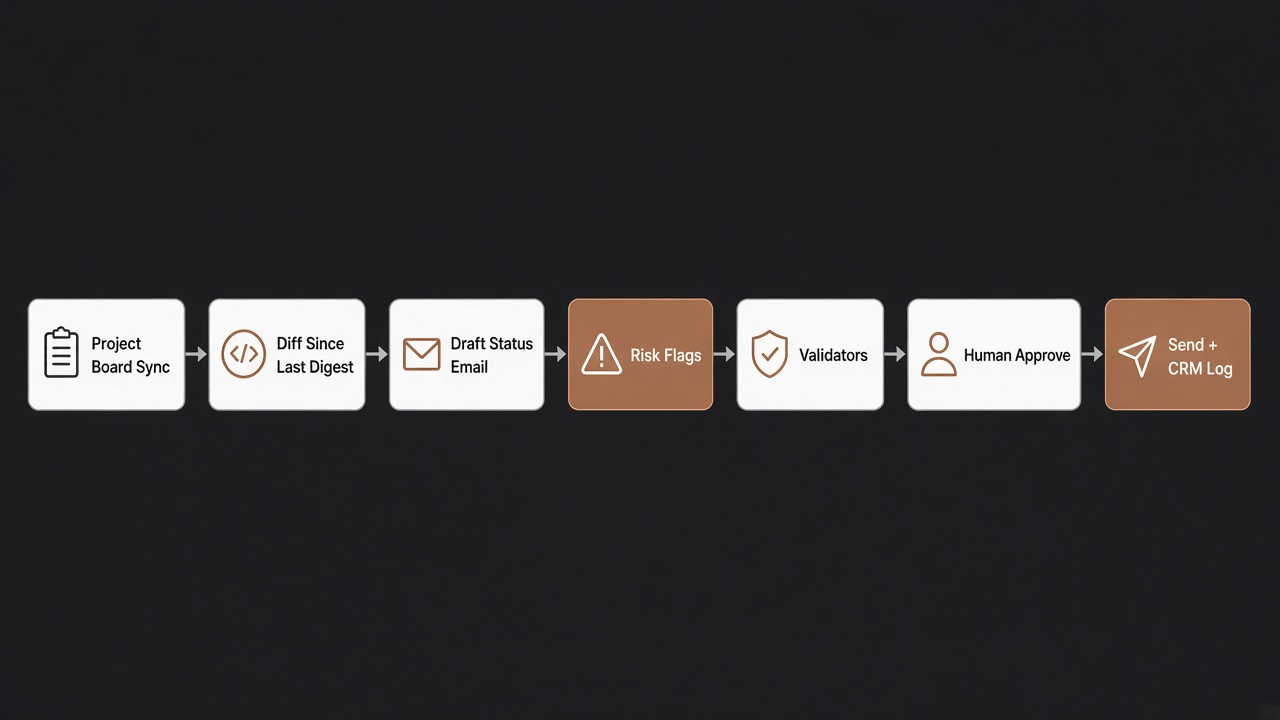
- Scheduler — weekly cron per active deal (timezone-aware).
- Board sync — tasks, statuses, assignees, due dates, labels (client-waiting).
- Diff engine — completed since last digest, newly blocked, milestone slippage.
- Draft writer — fills locked email/portal template from structured facts only.
- Validators — no naked %, no new dates, redact internal tags.
- Human gate + send — PM Approve/Edit; ESP send; CRM note.
Guardrails checklist (non-negotiable)
- Board as source of truth — every “Done” line maps to a task ID.
- No invented progress % — optional % only if computed from weighted tasks in config.
- Timeline lock — dates must stay inside the signed proposal band unless PM overrides.
- Client-waiting tag — items needing client input listed explicitly with owners.
- Redaction rules — strip labels like
internal,margin, vendor cost fields. - Tone gate — if >N critical blockers, force Escalate (AM rewrites) before send.
- Quiet hours + cadence — respect client timezone and max one digest / period.
- Send lock — API rejects outbound without
approved_by. - Idempotent digest key —
deal_id + week_startprevents duplicate emails.
Step-by-step build guide
Step 1 — Normalize the board schema
Map your tool to a common shape: task_id, title, status, client_visible, waiting_on_client, milestone_id, updated_at. Hide non-client columns at sync time.
Step 2 — Tie deals to boards (Parts 6–7 continuity)
Store board_id / project_url on the CRM deal created from proposal and onboarding. No orphan boards.
Step 3 — Diff since last digest
- Tasks moved to Done since
last_digest_at - New blockers / waiting-on-client
- Milestones past due vs plan
- Unchanged “In progress” older than N days (staleness flag)
Step 4 — Draft into a locked template
Sections: Greeting · This week’s progress · In flight · Waiting on you · Risks · Next week · Links (staging, assets). LLM writes prose from structured bullets only — it cannot add tasks that are not on the board.
Step 5 — Validators
- Every Done bullet has a task_id reference in metadata
- Deny-list: “guaranteed,” fake %, new ship dates
- Internal label leakage scan
- Blocker count → escalate path
Step 6 — Human Approve / Edit / Escalate
- Approve — send email/portal update
- Edit — PM softens tone, adds context, adjusts asks
- Escalate — commercial risk, scope fight, timeline slip needing AM
Step 7 — Send + log + handoffs
Send via ESP, write CRM activity, store digest HTML. Near launch week, mention open items that feed Part 9 launch checklist. After launch, stop weekly digests and switch to Part 8 proof intake.
Pseudo-flow (tool calling)
list_active_deals()sync_board(deal_id) → Task[]diff_since(deal_id, since) → Diffdraft_digest(diff, template_id) → Draftvalidate_digest(draft) → Reportrequest_pm_review(draft_id)send_digest(draft_id)— if approvedlog_crm(deal_id, digest_id)
2-week MVP plan
- Days 1–2 — Board field mapping + client_visible rules for one tool (e.g. Notion)
- Days 3–4 — Diff engine + digest template
- Days 5–6 — Drafter + validators
- Days 7–8 — PM Approve UI
- Days 9–10 — Email send + CRM note
- Days 11–12 — Scheduler + idempotent week keys
- Days 13–14 — Shadow on 2–3 live projects (PM still owns send)
Quality metrics
- % active projects with on-time digests
- PM edit distance before approve
- Invented-progress incidents (target: zero)
- Client “where are we?” inbound emails per week (should fall)
- Escalations caught before send
- Duplicate digest rate
Common failures
- Fake percentages — model invents “75% done”
- Internal leakage — cost or blame language reaches the client
- Auto-send Fridays — bad news lands without PM tone check
- Stale boards — digests reflect neglected task hygiene, not reality
- Date drift — bot “reassures” with a new launch Friday
- No deal link — can’t stop digests after launch or start Part 8
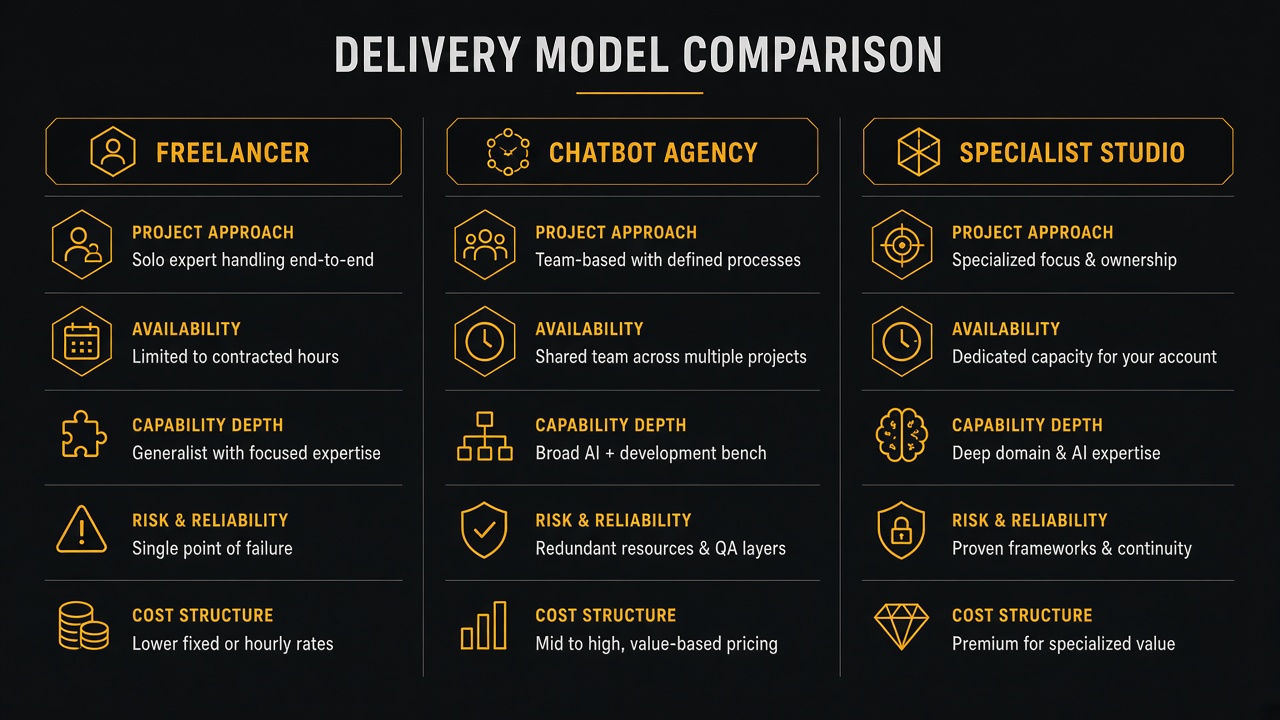
Freelancer vs chatbot agency vs specialist studio
| Solo freelancer | Typical chatbot agency | Let Start Design | |
|---|---|---|---|
| Source of truth | Memory / Slack | Prompt improvisation | Board sync + diffs + task IDs |
| Human gate | Optional | Often missing | Approve/Edit/Escalate required |
| Redaction | Manual hope | Weak | Label rules + validators |
| Delivery system fit | Split tools | Widget bolted on | Deal → board → launch → proof pipeline |
| Big-project capacity | Single point of failure | Juniors on “AI PM” | Structured build, QA, partner support |
| Commercial clarity | Hourly surprises | Opaque retainers | Scope via Project Builder + fixed proposals |
| Best for | Tiny builds | Generic chat digests | Multi-week deliveries where trust compounds |
How Let Start Design stands out
1) Agents with product discipline
Status digests get schemas, diffs, and gates — same bar as Parts 1–9. See what clients should expect from an AI website agency.
2) Continuity across the delivery funnel
Deal IDs from proposal/onboarding power boards, weekly digests, launch, then proof.
3) Guardrails before reassurance
We would rather hold a digest than send a comforting lie. Timeline locks and escalate paths come first.
4) Website + ops in one engagement
Often shipped beside AI website development so staging links and milestones match what the site project actually is.
5) White-label capacity
Agencies can offer status automation under their brand via our white-label program.
6) Portfolio proof
We run real multi-week deliveries — see the portfolio — where communication quality is part of the product.
Key takeaways
- Project boards are the source of truth; LLMs write the digest prose.
- Diffs beat full-board dumps; clients need “this week,” not noise.
- PM approval prevents fake % and date drift.
- Wire digests into the same deal ID as launch and proof bots.
- For bigger projects, hire a studio with integration capacity — Let Start Design combines agent engineering, website conversion, pricing clarity, and partner delivery.
Want status updates clients trust? Talk to Let Start Design, explore AI website development, or model scope in the Project Builder.
Series: Part 1 · Part 2 · Part 3 · Part 4 · Part 5 · Part 6 · Part 7 · Part 8 · Part 9 · Part 10 — Weekly status updates
Related: Agents vs chatbots vs copilots · White label in the age of AI · AI agency expectations
Sources: Structured outputs; Tool / function calling; JSON Schema.


