

Quick answer: When clients can “generate a site” with AI, agencies do not die — commodity web design dies. Agencies that survive sell trust, strategy, differentiation, compliance, and production systems that AI cannot fake. The winners use AI internally for speed, keep humans on brand judgment, and scale delivery through white-label partners so they can sell outcomes without becoming a template farm.
Every agency owner has heard it this year: “Why would I hire you when ChatGPT / Framer AI / [tool] can build my website?” That question feels like an extinction event. It is not. It is a market split — between websites that look finished and websites that win business.
This guide is written for agencies and studio founders who sell web design and development (and for partners evaluating white label web design & development). It pairs with our playbooks on finding a reliable white-label WordPress partner and outsourcing without clients finding out.
What actually changed when clients can generate a site
AI did not invent DIY websites. Templates did — years ago. What AI changed is the speed and confidence of non-designers:
- A founder can produce a “pretty enough” homepage in an afternoon
- Stakeholders confuse visual completeness with business readiness
- Price pressure hits agencies that sell only layouts and themes
- Buyers still get stuck on SEO, integrations, migrations, accessibility, performance, and conversion
Unique truth from delivery work: AI raises the floor of aesthetics and lowers the floor of strategy. Your job as an agency is to sell everything above the floor.
The Commodity Collapse Index (score your offer before you panic)
Rate your primary package from 0–2 on each factor (max 10). Under 6 = high AI-replacement risk.
| Factor | 0 (high risk) | 1 | 2 (defensible) |
|---|---|---|---|
| Differentiation | Generic “modern website” | Some niche language | Clear vertical POV + proof |
| Outcome clarity | Pages & pixels | Some KPIs | Leads, bookings, AOV, retention |
| System complexity | Brochure site | Forms + CMS | Integrations, data, multi-brand ops |
| Risk ownership | Client owns every failure | Shared | You own launch QA, SEO continuity, support |
| Relationship depth | One-off build | Small retainers | Roadmap + white-label production capacity |
If you score low, do not “add AI to the sales deck.” Redesign the offer.
AI template vs freelancer vs white-label agency (what clients actually buy)
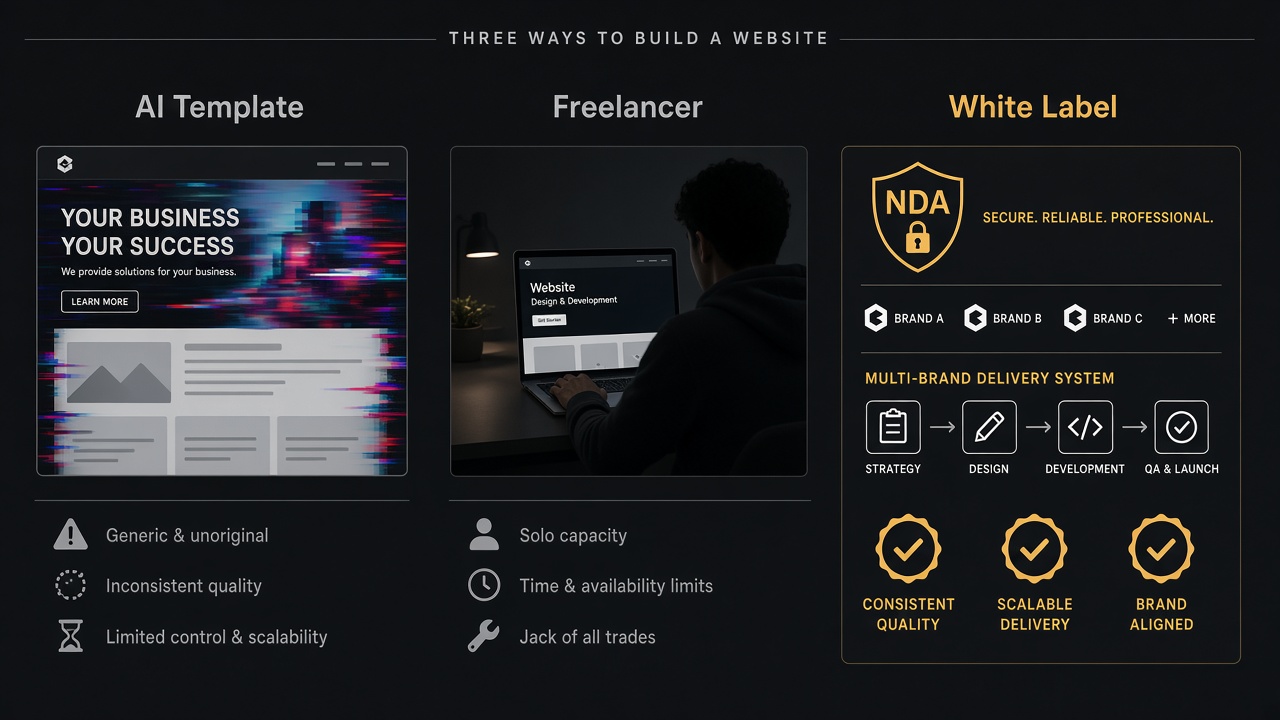
| Need | AI site generator | Solo freelancer | Agency + white label |
|---|---|---|---|
| Speed to first draft | Excellent | Good | Good (with AI-assisted production) |
| Brand uniqueness | Weak–medium | Depends on talent | Strong when process is real |
| SEO / migrations | Often shallow | Variable | Repeatable playbooks |
| Capacity spikes | Unlimited drafts, limited quality | Bottleneck | Elastic via partners |
| Client confidentiality | Tool ToS risk | Personal trust | NDA + delivery protocols |
| Multi-brand delivery | Poor | Hard | Built for it |
The Agency Survival Stack (what to sell instead of “a website”)

- Brand trust layer — reputation, case studies, references, clear ownership
- Process IP layer — discovery frameworks, QA checklists, migration maps clients cannot prompt into existence
- Vertical expertise layer — industry language, compliance nuance, conversion patterns
- White-label production layer — confidential capacity without hiring 12 seniors overnight
- AI-assisted delivery layer — draft faster, never ship unreviewed
Agencies that only sell layer 5 (AI speed) race to the bottom. Agencies that own layers 1–4 use AI as leverage.
Where white label becomes a survival advantage (not a secret shame)
White label is how serious agencies absorb demand spikes without diluting their brand. In an AI-pressure market, that matters more:
- You keep strategy and client relationship in-house
- You scale production through a vetted partner under NDA
- You still sell a premium front-end experience — not “we clicked generate”
- You can win retainers that AI tools do not service
If you need the operational playbook, start with how to outsource web design without your clients finding out, then use the partner checklist.
The AI-Proof Offer Matrix (repackage what you sell this quarter)
| Offer type | Easy for AI to fake? | Better 2026 packaging |
|---|---|---|
| 5-page brochure site | Yes | Position as starter only; attach SEO baseline + analytics |
| “Unlimited design” cheap retainers | Yes (race) | Cap scope; sell roadmap sprints |
| Custom brand system + site | Harder | Lead with brand decision frameworks |
| Migration / redesign without ranking loss | Hard | Productize with redirect + QA SOPs |
| Multi-location / multi-brand systems | Hard | Ideal white-label production use case |
| Conversion + CRM + lifecycle | Hard | Sell pipeline outcomes, not pages |
| AI-agent / Search readiness | Emerging | Bundle with content + technical hygiene |
For Search/AI visibility add-ons, point clients to durable fundamentals — not gimmicks — as covered in our guides on AI Overviews citations and AI-agent readiness.
How to answer the client objection (scripts that do not sound defensive)
“Can’t AI just build our site?”
Reply: “AI can draft a site. We build the business system around it — messaging, IA, integrations, SEO continuity, QA, and iteration. You’re not paying for rectangles. You’re paying for decisions that make the site produce revenue.”
“We already generated a homepage.”
Reply: “Great — that becomes a moodboard. Next we pressure-test conversion paths, technical debt, and brand uniqueness. Most AI drafts fail the second page and the fifth stakeholder.”
“A cheaper agency uses AI, why are you more?”
Reply: “We also use AI — for speed inside a controlled process. The fee difference is ownership: research, risk, performance, accessibility, and what happens after launch.”
Use AI inside the agency (without becoming a template mill)

A practical operating model:
- AI allowed: first-pass copy variants, layout exploration, alt-text drafts, test plans, internal summaries
- Human required: brand voice final, information architecture, claims accuracy, accessibility sign-off, SEO migrations
- Partner required when: capacity exceeds quality thresholds (not when you want to hide weakness)
- Never: pasting client confidential data into unvetted public tools
This matches the same philosophy as our AI product guide: choose the right autonomy for the job — see AI agents vs chatbots vs copilots.
90-day agency survival plan
Days 1–30 — Diagnose & reposition
- Score every package with the Commodity Collapse Index
- Kill or reprice offers that only sell “pages”
- Write 3 outcome-led offers (e.g. redesign without ranking loss, lead-gen site system, multi-brand rollout)
- Collect 5 proof artifacts (metrics, process screenshots, before/after) you can legally share
Days 31–60 — Install leverage
- Document SOPs for discovery, QA, launch, and handoff
- Select or upgrade a white-label partner with NDA + sample delivery standards
- Add AI tooling only where review gates exist
- Train sales on the objection scripts above
Days 61–90 — Sell the new story
- Update website/services messaging away from “we design websites” toward outcomes
- Publish 1 proof-led case study or teardown
- Pilot one AI-assisted delivery sprint with measured hours saved vs quality flags
- Set capacity rules: when work goes white-label vs stays in-house
Checklist: will your agency still win when clients can generate a site?
- ☐ You sell outcomes and risk ownership, not only layouts
- ☐ Commodity Collapse Index ≥ 7 on hero packages
- ☐ Vertical or process proof competitors cannot prompt overnight
- ☐ AI used as draft leverage with human gates
- ☐ White-label capacity exists for spikes without brand leaks
- ☐ Objection scripts practiced by sales/CS
- ☐ Migration / SEO / accessibility / integrations are productized
- ☐ Pricing reflects systems thinking, not template hours
Key takeaways
- AI site generators compress aesthetic commodity work — not trust, strategy, or complex delivery.
- Score your offers; redesign anything AI can fake cheaply.
- White label is a capacity and confidentiality system, not a shortcut to mediocrity.
- Use AI inside the agency; sell human judgment and production reliability to clients.
- Survive by stacking brand trust, process IP, vertical expertise, partners, and AI leverage.
If you want a confidential white-label production partner — or help reposition your agency offers for the AI era — talk to Let Start Design. Explore white label partnership, services, and portfolio.
Related: Reliable white-label WordPress partner · Outsource without clients finding out · Agents vs chatbots vs copilots · Change platforms without losing rankings.
Sources / further reading: Google Search Central — Creating helpful, reliable, people-first content; NIST AI Risk Management Framework (useful lens when agencies adopt AI in client delivery).


