

Quick answer: To get your website cited in Google AI Overviews, publish indexed, snippet-eligible pages with clear answers, unique evidence (first-hand experience, original data, or specific process detail), and strong crawlability. Google’s generative AI features are grounded in core Search — there is no special AI schema or llms.txt requirement. Focus on non-commodity, people-first content and measure impressions in Search Console’s Generative AI report.
Checking whether you appear in AI Overviews is step one. Getting cited on purpose is step two. This playbook is the action plan that follows our guide on how to check if your website appears in Google AI Mode & AI Overviews.
It is written from an agency delivery perspective — the same standards we use when rebuilding client and white-label sites at Let Start Design — and aligned with Google’s official guide to optimizing for generative AI features and AI features documentation.
How do Google AI Overviews choose supporting links?
Google explains that generative AI features on Search rely on techniques such as:
- Retrieval-augmented generation (RAG / grounding) — retrieve relevant pages from the Search index, then use specific information from those pages to support the response with clickable links.
- Query fan-out — run related sub-queries so the system can gather a wider set of useful sources for complex questions.
Unique implication: you are not only competing for one headline keyword. Your page can be selected because it strongly answers a fan-out subtopic (for example, “redirect mapping,” “staging QA,” or “Merchant Center feed errors”) even when that phrase is not the H1.
The Citation Readiness Score (our practical framework)
Before rewriting your whole blog, score each money page from 0–2 on five factors (max 10). Prioritize pages that already get Search impressions but score under 7.
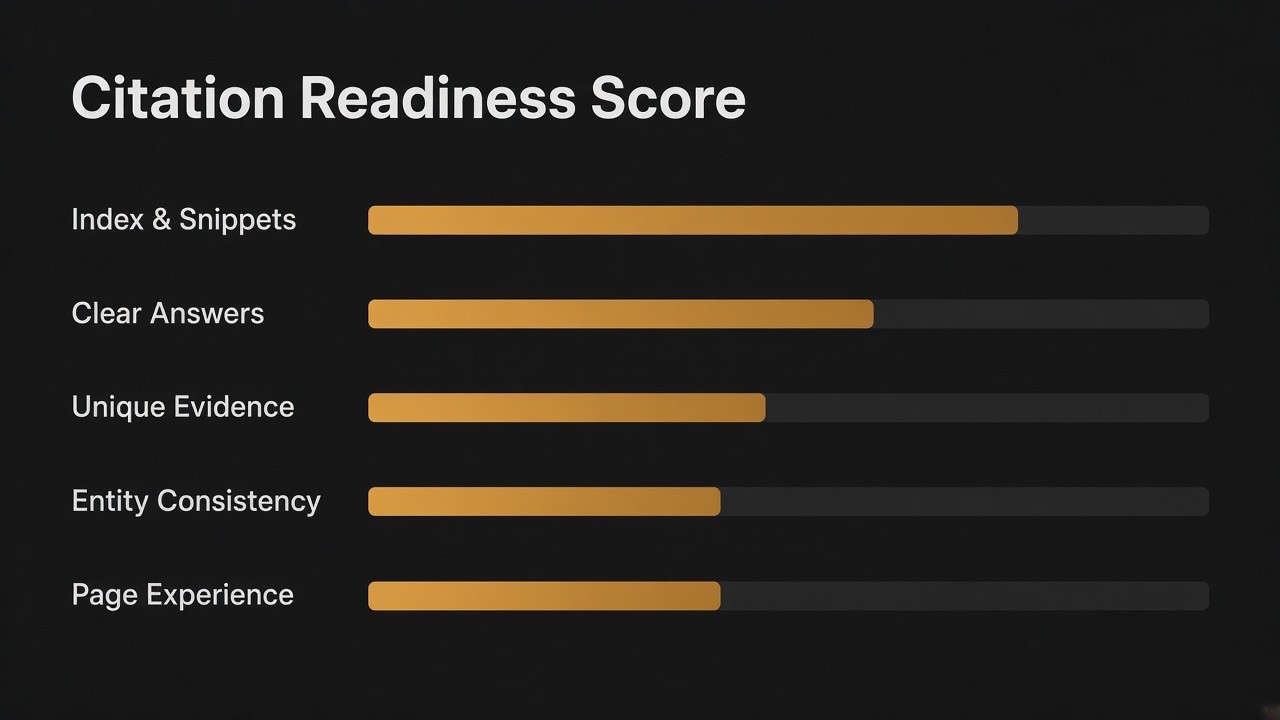
| Factor | 0 | 1 | 2 |
|---|---|---|---|
| Index & snippets | Not indexed / blocked | Indexed, weak snippet | Indexed + clean snippet eligibility |
| Clear answers | Vague marketing copy | Answers buried mid-page | Direct answer near the top + scannable sections |
| Unique evidence | Generic tips anyone could write | Some specifics | First-hand process, screenshots, numbers, or original examples |
| Entity consistency | Conflicting brand/NAP facts | Mostly consistent | Same brand facts across About, Contact, GBP, schema |
| Page experience | Hard to read on mobile / cluttered | Usable | Fast, clear main content, helpful media |
Agency tip: run this score in a client workshop. It stops “AI SEO” debates and turns the work into five concrete tickets.
What you do NOT need (Google mythbusting)
Google is explicit that these tactics are not required for generative AI features in Search:
- Special AI text files (such as llms.txt) for Google Search visibility
- Artificial “chunking” of content into tiny AI-only blocks
- Rewriting pages just to sound like an AI answer engine
- Buying inauthentic mentions
- Extra schema invented only for AI Overviews
Structured data can still help classic rich results — keep using it where it matches visible content — but it is not a secret AI Overviews ranking switch.
Step 1: Make the page eligible to be cited
Eligibility is boring and non-negotiable:
- Confirm the URL is indexed (Search Console URL Inspection).
- Confirm it can show a snippet (watch
noindex,nosnippet, overly aggressivemax-snippet). - Confirm Googlebot can crawl important text (not trapped in blocked JS or images-only claims).
- Confirm the site is included in Search generative AI features in Search Console (Google notes this as part of eligibility).
If eligibility fails, content quality work will not matter for AI Overviews citations.
Step 2: Build “fan-out clusters,” not keyword clones
Query fan-out means one user question can spawn related retrievals. The unique opportunity is to cover a cluster of decisions with distinct pages — not ten near-duplicate “AI Overview tips” posts.
Example cluster for website redesign:
- Pillar: how to redesign a website without losing rankings
- Fan-out page A: redirect mapping checklist (with a real sample table)
- Fan-out page B: staging QA tests we run before launch
- Fan-out page C: metadata and internal-link recovery after launch
Each page should own one job. Creating separate pages for every synonym primarily to manipulate AI responses can violate Google’s scaled content abuse policies — so expand only when the page adds unique utility.
Step 3: Raise evidence density (the real differentiator)
Google contrasts commodity content (“7 tips…”) with non-commodity content grounded in experience. For AI Overviews, we translate that into evidence density: how many verifiable, non-generic claims appear per screen.
Raise density with details competitors cannot copy overnight:
- Exact process steps you use on client builds
- Before/after measurements you are allowed to share
- Failure cases (“what broke when we skipped X”)
- Screenshots of Search Console or staging tools (scrub private data)
- Decision rules (“choose Shopify when…; choose WordPress when…”)
Unique detail from agency work: citation-prone pages often answer a micro-decision, not a broad lifestyle topic. “How we map 180 URLs during a WordPress migration” outperforms “Website tips for success.”
Step 4: Write for humans with citation-friendly structure
You do not need an “AI tone.” You do need structure people (and systems) can parse:
- Put a direct answer near the top
- Use clear H2/H3 questions that match real intents
- Keep definitions in HTML text, not only in graphics
- Add useful images/video when they clarify the topic
- Separate main content from chrome (nav, popups, decorative noise)
If generative AI tools help you draft, the published page must still meet Search Essentials and spam policies — human review, accuracy checks, and unique insight are required.
Step 5: Strengthen entity consistency across the site
AI systems retrieve pages from an index that also understands brands and businesses. Inconsistent facts make you harder to trust as a supporting source.
- Same legal/brand name on title tags, About, footer, and schema
- Same phone, email, and address where you publish NAP
- Up-to-date Google Business Profile for local queries
- Author pages with real credentials for expert articles
- Service pages that define what you do in plain language
For ecommerce or product-led answers, Google also points to Merchant Center and Business Profile quality as visibility helpers in generative experiences where product/local details matter.
Step 6: Fix the five citation killers we see most often
- Answer trapped in a hero animation or image — Googlebot needs the text.
- Thin service pages that only say “we are the best” with no process or scope.
- Duplicate blog remixes that restate the same tips with new titles.
- Orphan URLs with no internal links from relevant hubs.
- Snippet controls left on from an old security or redesign experiment.
Step 7: Measure citations the honest way
- Use Search Console’s Generative AI performance report for impression trends by page, country, device, and date.
- Keep a monthly manual audit of priority queries (AI Overviews + AI Mode separately).
- Track engagement after clicks in Analytics — Google has noted higher-quality visits from AI Overview contexts in its documentation around AI features.
Be skeptical of third-party tools that claim internal Google AI ranking access. Google states no third-party tool has that access.
30-day citation sprint (agency operating plan)
- Days 1–3: Pull Generative AI impressions + classic query winners. Pick 10 URLs.
- Days 4–7: Score each URL with Citation Readiness. Fix all eligibility issues.
- Days 8–18: Upgrade the top 5 pages: direct answers, evidence blocks, clearer headings, supporting media.
- Days 19–24: Publish or improve 2 fan-out support pages that cover real sub-decisions.
- Days 25–30: Recrawl requests, internal-link from hubs, re-check manual citations, log wins/losses.
When you should not chase AI Overviews
Skip the chase when:
- The query never triggers an Overview in your market
- Your business depends on demos/sales calls more than informational citations
- You would need spammy scaled pages to “cover every fan-out”
- Classic Search conversions are already strong and resources are limited — improve those pages first; AI features still rely on the same quality foundation
Key takeaways
- Getting cited starts with indexation and snippet eligibility, then unique helpful content.
- Query fan-out rewards distinct, useful subtopic pages — not synonym spam.
- Evidence density beats generic tip lists.
- Ignore AI-only file myths; follow Google’s foundational SEO guidance.
- Measure with Search Console Generative AI impressions plus manual citation checks.
If you want a hands-on citation readiness audit for your site — eligibility fixes, content upgrades, and a 30-day sprint plan — talk to Let Start Design. We build and optimize websites for durable Search visibility, including generative AI features grounded in Google Search.
Sources: Optimizing for generative AI features (Google Search Central); AI features and your website; Generative AI performance report.


