

Quick answer: Semantic SEO means optimizing for meaning — entities, search intent, and topical relationships — instead of repeating one keyword string. In 2026 that also means writing answer-ready pages that Google and AI assistants can cite. Build hub-and-spoke clusters, define entities clearly, prove first-hand experience, link related pages on purpose, and measure related queries in Search Console.
This is the hub of our SEO cluster: best SEO courses, best SEO guides, authentic backlinks, and our free backlinks list (CSV). It also pairs with AI Overviews citations and AI search beyond Google.
At Let Start Design we use this system on client sites and our own journal. Below is a practical playbook you can run this month — not theory theater.
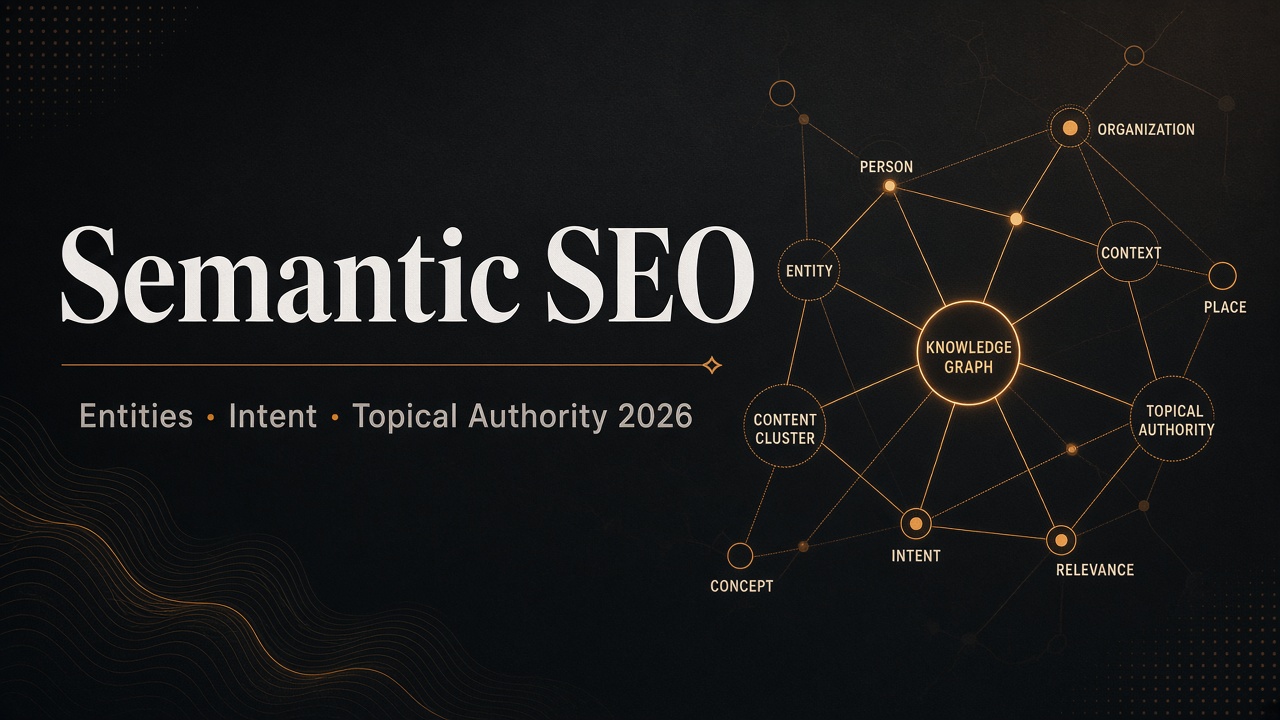
What semantic SEO really means (plain English)
Search engines try to understand what a page is about and what the searcher wants to accomplish. Semantic SEO is how you design content and internal links so that understanding is easy:
- Entities — named things: brands, tools, cities, standards (e.g. Core Web Vitals, Search Console)
- Intent — know / compare / do / buy / fix
- Attributes — cost, timeline, risk, steps, requirements
- Relationships — “X vs Y”, “X for Z”, “how X connects to Y”
Example: for “AI website development,” related entities include Next.js, WordPress, migration, pricing, agency process, and SEO. A semantic site covers those relationships with distinct pages that point to each other — not one bloated mega-post.
Semantic SEO vs old-school keyword SEO
| Keyword-first | Semantic-first | |
|---|---|---|
| Page goal | Rank for one string | Own a topic + related intents |
| Writing | Repeat the phrase | Answer the job + name entities |
| Internal links | Random “related” | Hub → spoke cluster |
| Success | One ranking | Query family + citations |
| Failure mode | Cannibalization | Thin spokes with no hub |
Step-by-step: ship a semantic cluster in 2 weeks
Week 1 — Map the topic
- Pick one money topic (service or problem you sell against).
- List 8–15 real questions customers ask on calls (cost, timeline, risk, vs alternatives, process).
- Group questions into intents: learn / compare / implement / hire.
- Choose one hub URL (this guide style) and 3–6 spoke URLs.
- Write entity glossary for the topic (names you will use consistently).
Week 2 — Write and interlink
- Hub first: Quick answer → framework → steps → mistakes → FAQ.
- Spokes next: each spoke goes deep on one intent only.
- Link up: every spoke links to the hub in the intro and outro.
- Link across: 1–2 sibling links where genuinely helpful.
- Hub links down: visible cluster block naming every spoke.
- Submit in GSC and watch related queries for 2–4 weeks.
Our live cluster follows that pattern: this hub ↔ courses ↔ guides ↔ backlinks ↔ free backlinks list.
On-page pattern that works for classic search + AI citations
- Quick answer in the first screen (2–4 sentences, self-contained).
- What / why with plain definitions.
- Process or framework with numbered steps.
- Comparison table when buyers must choose.
- Evidence — screenshots, constraints, real tradeoffs (not generic tips).
- Mistakes section (builds trust; AI systems often cite caveats).
- FAQ matching real People-Also-Ask language — visible on the page.
- Next steps + honest internal links to services or tools.
That structure mirrors how we brief SEO services and AI website development content — answer first, proof second.
Technical SEO that supports semantics (don’t skip)
- One clear H1; descriptive H2/H3 that match intents
- Crawlable HTML (don’t hide primary answers only in images)
- Canonicals, sitemap, robots correct after launches — see our launch checklist thinking
- Schema that matches visible content (Article, FAQ, Organization)
- Fast templates (LCP/INP) so experience doesn’t tank engagement
- Meaningful anchors (“semantic SEO cluster”), not “click here”
How to measure if semantic SEO is working
- Query families in Search Console — more related questions, not only one head term
- Impressions on spokes after hub publishes (cluster lift)
- Internal click paths hub → spoke in analytics
- AI appearance checks — AI Mode & Overviews
- Assisted conversions from organic landings in the cluster
Common failures (and fixes)
- Thesaurus stuffing — fix: write for humans; name entities once clearly
- 30 thin posts — fix: one strong hub + fewer deep spokes
- No internal links — fix: cluster block + contextual links
- FAQ schema without visible FAQs — fix: show the same Q&As on the page
- Ignoring links — semantics need trust; use authentic backlinks, not PBNs
How Let Start Design applies semantic SEO
We plan IA and clusters before visual polish, then ship pages with answer-led structure, proof, and measurement. Model related work in the Project Builder or talk to us about SEO + site delivery as one system.
Key takeaways
- Optimize for entities, intent, and coverage — not keyword count.
- Ship hub-and-spoke clusters with deliberate internal links.
- Lead with citable answers; back them with real experience.
- Technical SEO supports semantics; it does not replace it.
- Train with courses and guides, then earn real links.
SEO cluster: Semantic SEO · Courses · Guides · Backlinks · Free backlinks list
Sources: Google Search Central; SEO Starter Guide.


