

Quick answer: AI website development wins when you need speed, exploration, and a strong first draft of structure, UI, and code — especially for marketing sites, landing pages, and MVPs. Traditional builds win when risk, compliance, complex ecommerce, deep integrations, or brand differentiation cannot tolerate shortcuts. Most serious projects win with a hybrid: AI for acceleration, senior humans for strategy, QA, SEO, and launch. Use our Project Builder to model cost before you commit, then hire a team that can finish — not just generate.
If you are comparing quotes right now, you are probably hearing two stories. Freelancers promise “I’ll build it with Cursor / Lovable / ChatGPT in a week.” Traditional agencies promise “custom everything” and a timeline that stretches for months. Both can be right. Both can also waste your budget.
This guide breaks down AI website development vs traditional builds by the only three variables that matter for a business decision: cost, speed, and risk. We also show where Let Start Design sits — and why bigger projects usually need more than a solo freelancers AI stack or a slow, template-heavy agency.
What “AI website development” actually means
AI website development is not “click a theme generator and hope.” In a professional setting it means humans still own the brief, the information architecture, and the final quality bar — while AI tools accelerate:
- Research packs, competitor maps, and content outlines
- Wireframe and UI variant exploration
- Scaffolding for Next.js, WordPress, or Shopify sections
- First-pass copy, FAQs, and schema drafts
- Refactoring, tests, and repetitive front-end tasks
At Let Start Design, that workflow is our AI website development service: AI for speed, senior designers and engineers for judgment. If a vendor only ships whatever the model spat out, that is DIY generation — not development.
What “traditional builds” still do better
Traditional builds emphasize discovery workshops, handcrafted design systems, deliberate engineering, staged QA, and documented handoff. They shine when:
- The brand must look unmistakably custom (category leaders, luxury, regulated industries)
- Catalog, pricing, membership, or ERP logic is genuinely complex
- You need migrations, redirects, and SEO continuity under pressure
- Multiple stakeholders need reviews, approvals, and change control
- Failure modes are expensive (checkout, auth, payments, compliance)
Traditional does not mean “no AI.” It means AI is optional tooling — not the product. The process and accountability stay human-led.
Cost, speed, risk — the real comparison
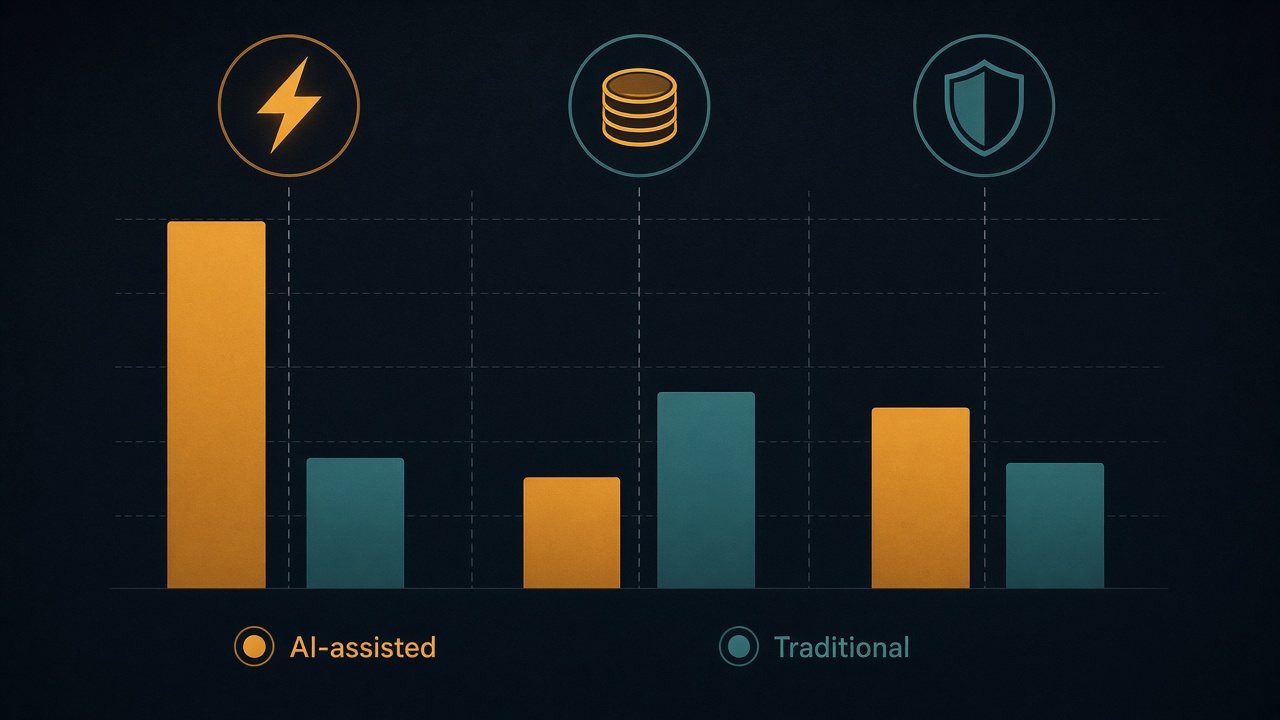
| Factor | AI-accelerated build | Traditional build | Hybrid (recommended for most brands) |
|---|---|---|---|
| Cost | Lower for MVPs and marketing sites; cheap only if scope stays honest | Higher up front; buys process, QA, and fewer rewrites | Mid-range: pay for judgment where risk lives |
| Speed | Fastest first drafts and page variants | Slower by design (reviews, systems) | Fast exploration + controlled polish |
| Risk | Highest if unsupervised (a11y, SEO, security, sameness) | Lowest process risk when the team is senior | Lowest business risk for growth sites |
| Best for | Landing pages, MVPs, content-heavy rebuilds with clear IA | Complex ecommerce, multi-system, regulated, high-stakes brands | Most serious marketing and commerce sites |
Cost tricks buyers miss
- Cheap AI quotes hide finish work. Accessibility, responsive QA, form validation, analytics, redirects, and content migration are where money returns.
- Traditional retainers hide idle time. Ask for a milestone plan, not open-ended “discovery forever.”
- Scope the product, not the tool. “Built with AI” is not a deliverable. Pages, integrations, SEO, and ownership are.
- Model numbers before you negotiate. Use our interactive Project Builder for a live USD range (Quick Estimate or Exact Project), then ask vendors to explain deltas.
Speed tricks that actually work
- Freeze IA and sitemap before visual exploration — AI thrives with constraints.
- Approve one design direction early; do not regenerate ten unrelated aesthetics.
- Ship a conversion-critical page first (home or key service), then parallelize interiors.
- Keep content owners on a 48-hour review SLA — AI cannot fix stakeholder silence.
Risk tricks that protect big projects
- Ban auto-publish and auto-deploy from AI tools into production.
- Require an accessibility and keyboard pass before launch.
- Demand technical SEO basics: titles, meta, headings, schema, sitemap, Core Web Vitals budget.
- For AI-generated starters (Cursor, Lovable, Bolt, v0), budget a finish phase — polish, harden, and document — instead of pretending the prototype is the product.
- Make permissions and secrets explicit. Models should never invent pricing, legal claims, or medical advice on live pages.
When each approach wins
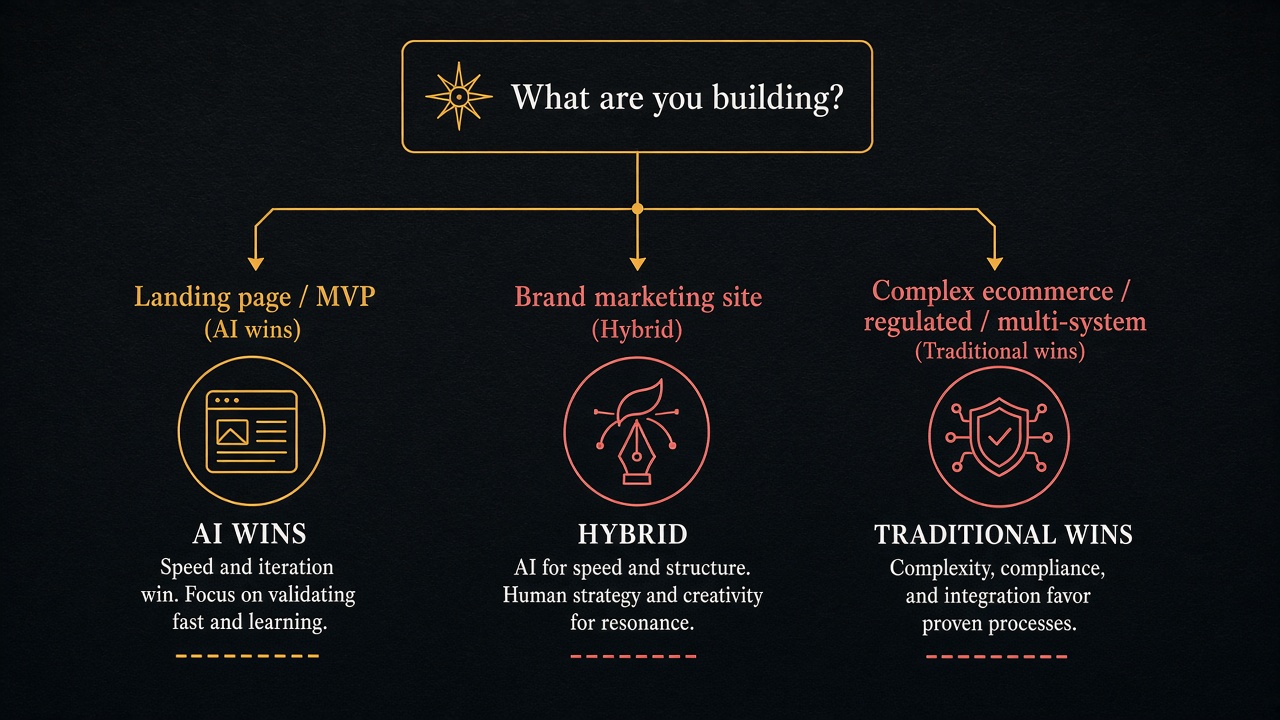
AI-accelerated builds win when…
- You need a credible marketing site or campaign landing page in weeks
- The offer is clear and the content model is mostly pages + forms + CMS
- You are testing positioning and need rapid page variants
- You already have brand assets and a decisive stakeholder
- Budget is real but not “enterprise transformation”
Traditional builds win when…
- Checkout, subscriptions, wholesale pricing, or multi-warehouse logic is core
- You integrate CRM/ERP, custom auth, or multi-tenant portals
- Brand differentiation is the product (design system maturity matters)
- Legal, healthcare, finance, or other compliance constraints apply
- You are migrating a ranking site and cannot gamble on redirects
Related deep dive: how to change website platform without losing Google rankings.
Hybrid wins for most growth brands
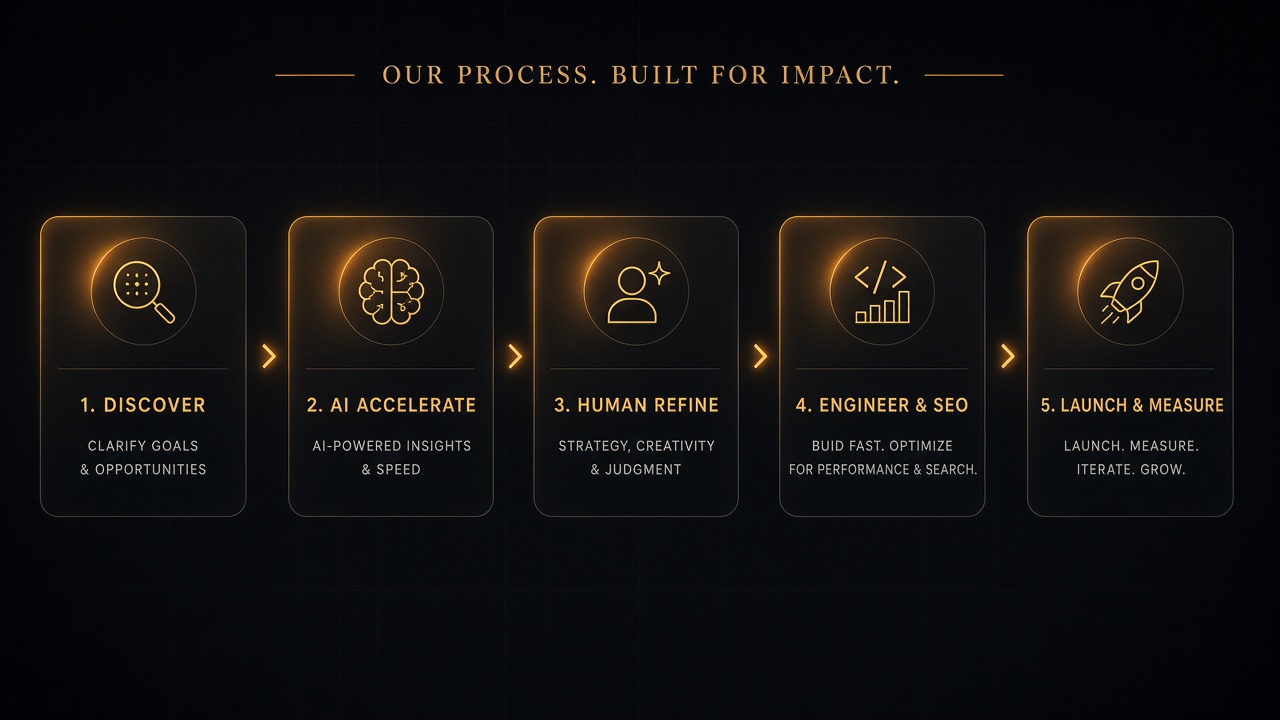
Hybrid is where Let Start Design operates day to day: AI compresses research, UI exploration, and scaffolding; humans lock strategy, refine conversion, engineer for performance, and own launch. You get traditional accountability at AI-era velocity.
Freelancer vs typical agency vs specialist studio
For bigger projects, the question is not “AI or not.” It is who owns outcomes when AI makes everyone look fast in week one.
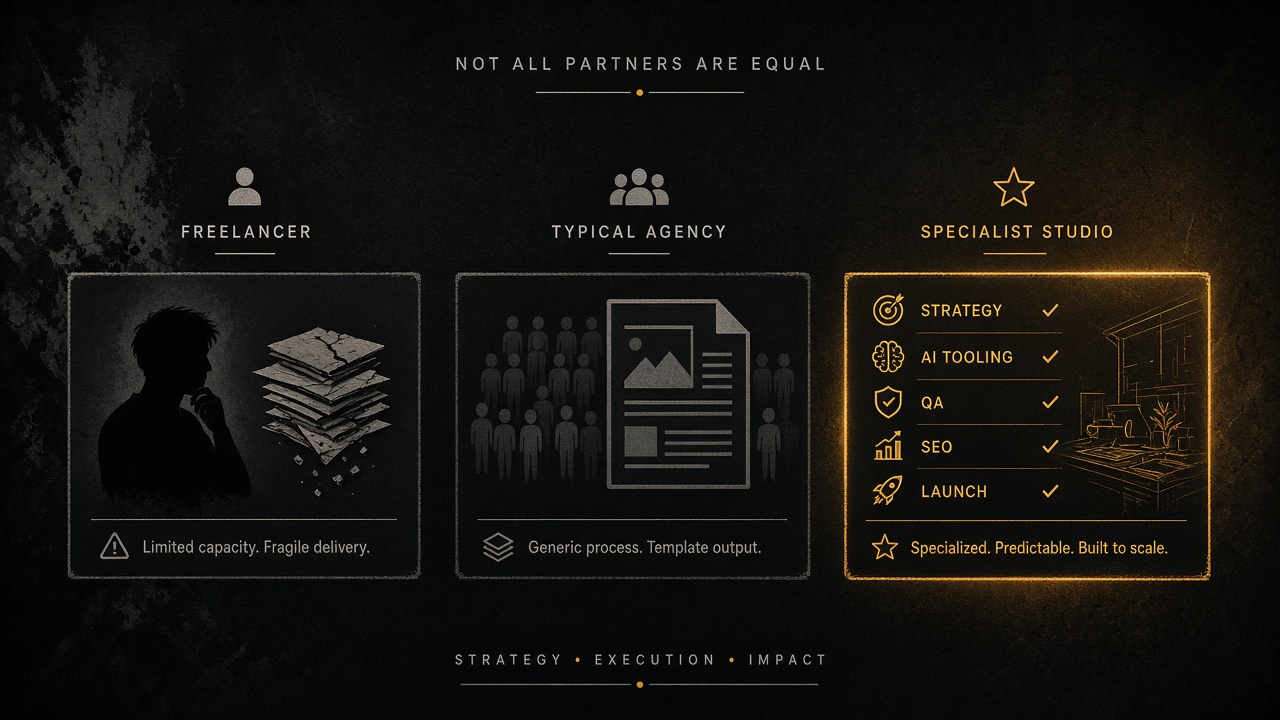
| Solo freelancer | Typical agency | Let Start Design (specialist studio) | |
|---|---|---|---|
| AI usage | Often tool-first; quality varies by one person’s taste | Sometimes slow to adopt; sometimes template + AI filler | AI-assisted production with senior human gates |
| Big-project capacity | Single point of failure; vacations and burnout risk | Capacity exists, but juniors may own critical paths | Structured delivery across design, build, SEO, launch |
| Process | Informal Slack threads | Decks and meetings — can over-process | Milestone scopes, live estimates, clear change control |
| SEO & performance | Optional add-on | Often a different department | Built into the website engagement |
| White-label / partner work | Hard to scale invisibly | Mixed | White-label partnership ready for agencies |
| Best hire for | Small pages, experiments | Brand campaigns with large account teams | Serious websites that must convert, rank, and ship |
How Let Start Design stands out on bigger projects
We are not “cheaper than a freelancer because AI.” We are the team you hire when a bigger project needs speed without gambling the brand.
1) Transparent pricing before the pitch theater
Most freelancers quote from vibes. Many agencies quote after three workshops. We built a public Project Builder so you can configure platform, pages, ecommerce, SEO, and add-ons and see a live USD range — Quick Estimate for a ballpark, Exact Project for a blueprint. That does not replace a fixed proposal. It does kill mystery pricing.
2) AI that shortens delivery — not your standards
Our AI website development model uses AI for drafts and variants, then designers and engineers refine for brand, conversion, accessibility, and Core Web Vitals. You do not get a generic “AI look.” You get a custom site that happens to ship faster.
3) Full-stack craft across WordPress, Shopify, and Next.js
Big projects rarely stay on one toy stack. We ship and maintain work across WordPress, Shopify, and custom/Next.js builds — including redesigns that protect search equity. See the portfolio for production evidence, not mock slides.
4) SEO and AI-search readiness in the same engagement
A pretty site that cannot be cited or crawled is unfinished. We bake technical SEO, answer-ready structure, and agent-readiness thinking into builds — the same discipline we write about in guides like AI-agent ready websites and AI search beyond Google.
5) Agency partners get invisible capacity
If you are an agency drowning in production, our white-label program lets you sell under your brand while we deliver. In an era where clients can generate a site, agencies that survive sell trust and systems — we wrote about that in White Label in the Age of AI.
6) We finish AI starts
Many “big” disasters begin as exciting Cursor or Lovable prototypes. We regularly take incomplete AI-generated codebases and harden them: responsive polish, CMS, auth, deploy, performance, and production QA. That finish path is available in our pricing builder under AI-assisted project types — because reality is messy, and pretend-perfect demos are not.
Practical guide: choose your path in 20 minutes
- Write the outcome in one sentence. “Generate qualified demos” beats “modern website.”
- List must-have systems. CMS, payments, membership, multilingual, CRM sync — anything that touches money or identity raises risk.
- Score differentiation. If a competitor could swap logos onto a template and fool your buyers, you need more craft.
- Pick a delivery mode. AI-accelerated, traditional, or hybrid using the tables above.
- Run the Project Builder. Capture a range on /pricing so every vendor quote is comparable.
- Interview for finish discipline. Ask: Who does a11y QA? Who owns redirects? Who reviews AI output? What happens after launch?
- Hire for capacity on the critical path. For six-figure or multi-stakeholder projects, avoid single-freelancer dependency.
Buyer checklist (copy this into your RFP)
- □ Sitemap and page list approved
- □ Success metrics defined (leads, AOV, support deflection — pick one primary)
- □ Platform decision (or “recommend with rationale”)
- □ Integrations list with owners of API access
- □ SEO migration plan if replacing a live site
- □ Accessibility acceptance criteria
- □ Content responsibility matrix (who writes, who approves)
- □ Staging URL + launch checklist
- □ Post-launch support window
- □ Clear statement: AI may assist; humans own production quality
Common mistakes we see (and how to avoid them)
- Hiring the cheapest AI demo. Demos are not production. Ask for a production URL like yours.
- Paying traditional agency rates for template skins. Demand custom components and a design system, or pay AI-hybrid rates instead.
- Skipping content strategy. AI fills pages with words; strategy decides which pages deserve to exist.
- Ignoring mobile and form QA. Most lead loss is boring, not aesthetic.
- No change budget. Bigger projects always discover scope in week three — contract for it.
Key takeaways
- AI website development wins on speed and early cost for focused marketing builds.
- Traditional builds win when complexity, compliance, or brand risk dominate.
- Hybrid delivery is the default for serious brands — AI accelerate, humans decide.
- For bigger projects, hire capacity and finish discipline — not just a clever prompt library.
- Let Start Design combines AI-assisted production, multi-platform craft, SEO foundations, transparent Project Builder pricing, and white-label partner capacity.
Ready to model your scope? Open the Project Builder, or book a consultation and we will recommend AI-accelerated, traditional, or hybrid delivery for your real constraints — not the internet’s latest tool hype.
Related: AI Website Development · Web Development · Website Redesign · White Label in the Age of AI · AI Agents vs Chatbots vs Copilots


